

Fraud detection is available as part of Nova’s scoring pipeline. Contact your account manager to enable it for your organization.
How It Works
Nova scores the candidate
When a new application comes in, Nova scores it against your configured criteria as usual.
High-scoring candidates are analyzed for fraud
If the candidate scores at or above your fraud detection threshold (default: 7/10), Nova runs a separate fraud analysis. This analysis combines resume text analysis with multiple independent external validation signals.
What Nova Analyzes
Nova evaluates resumes across multiple independent dimensions. When concerns from different dimensions converge, the fraud probability increases. When only surface-level issues are present, risk stays low.| Dimension | What it checks |
|---|---|
| Timeline integrity | Overlapping dates, impossible sequences, future-dated roles |
| Career progression | Seniority jumps that skip expected intermediate levels |
| Skill credibility | Implausibly broad technology lists spanning unrelated domains, keyword stuffing |
| Quantitative claims | Repeated large impact numbers without baselines or context |
| Document metadata | Suspicious PDF creation tools and document assembly artifacts |
| Email verification | Email deliverability, account age, and breach history |
| LinkedIn validation | Profile completeness, activity history, and profile authenticity |
| Cross-candidate detection | The same contact details appearing across multiple “different” applications |
| AI generation patterns | Resumes that read like uniform templates with zero authentic workplace detail |
Nova distinguishes between normal resume polish (which is standard career advice) and pervasive patterns that suggest fabrication. A few metrics-driven bullet points are not suspicious. An entire resume that reads like a template with no project names, team names, or specific workplace detail is a different story.
Reading the Risk Assessment
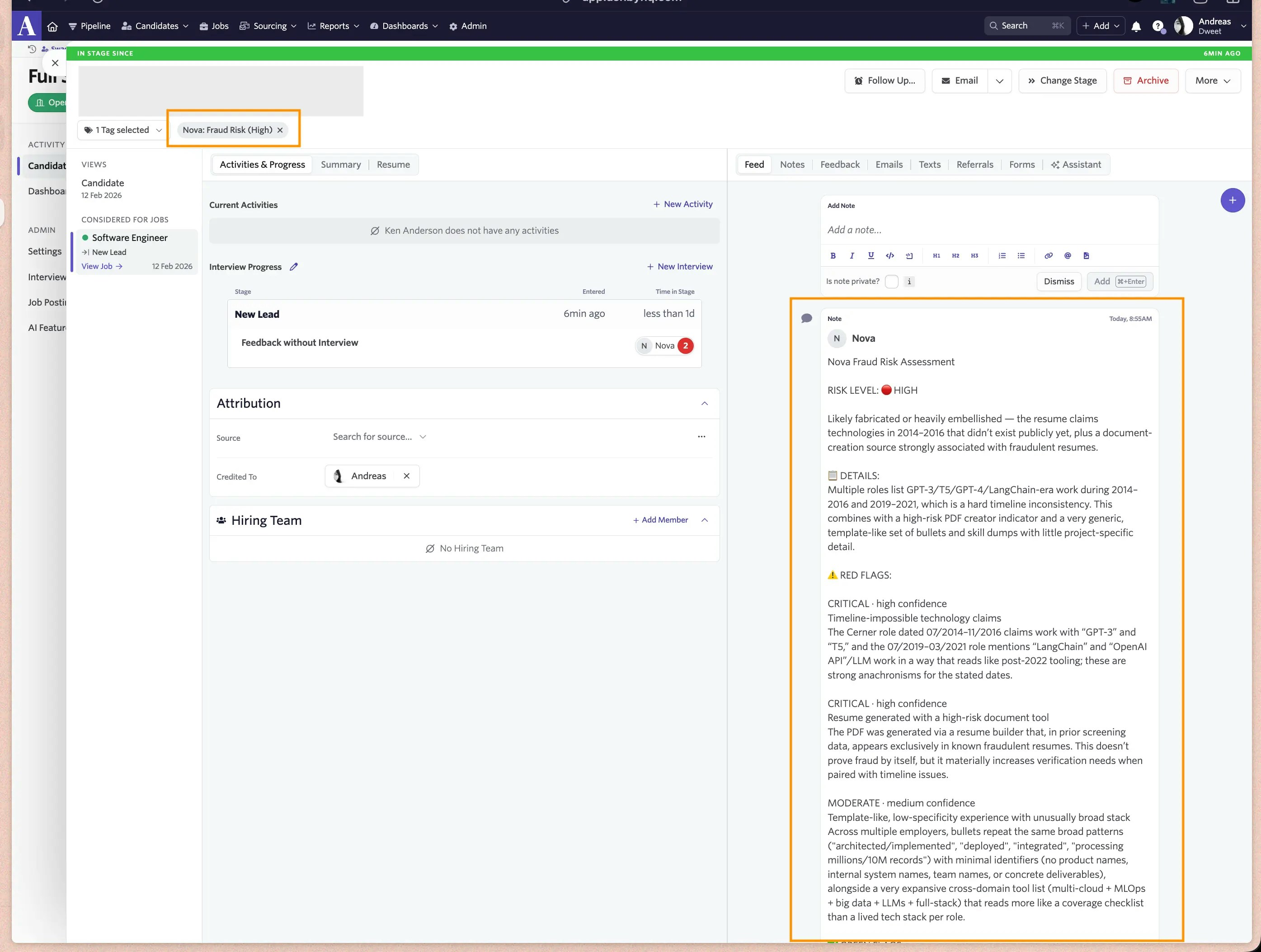
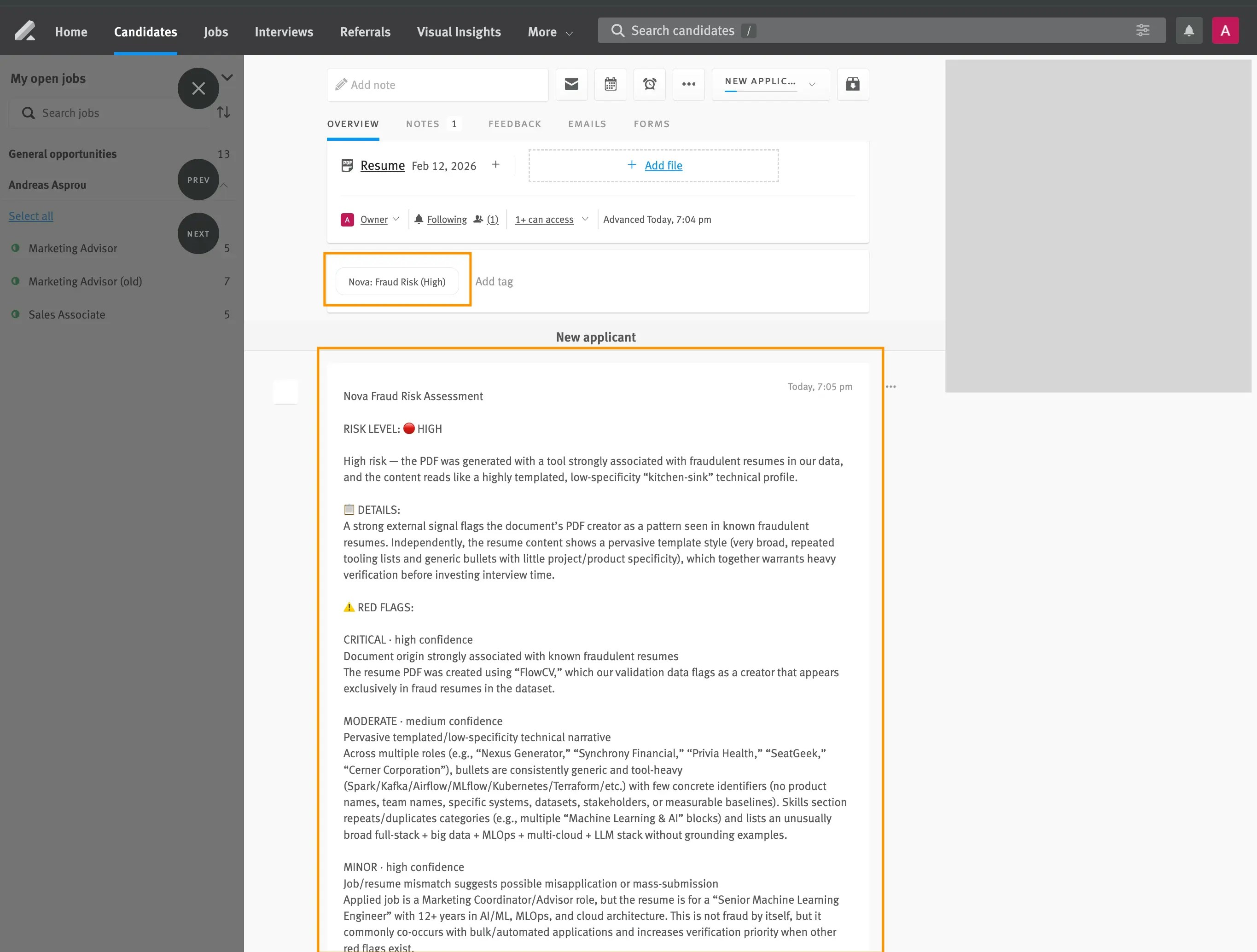
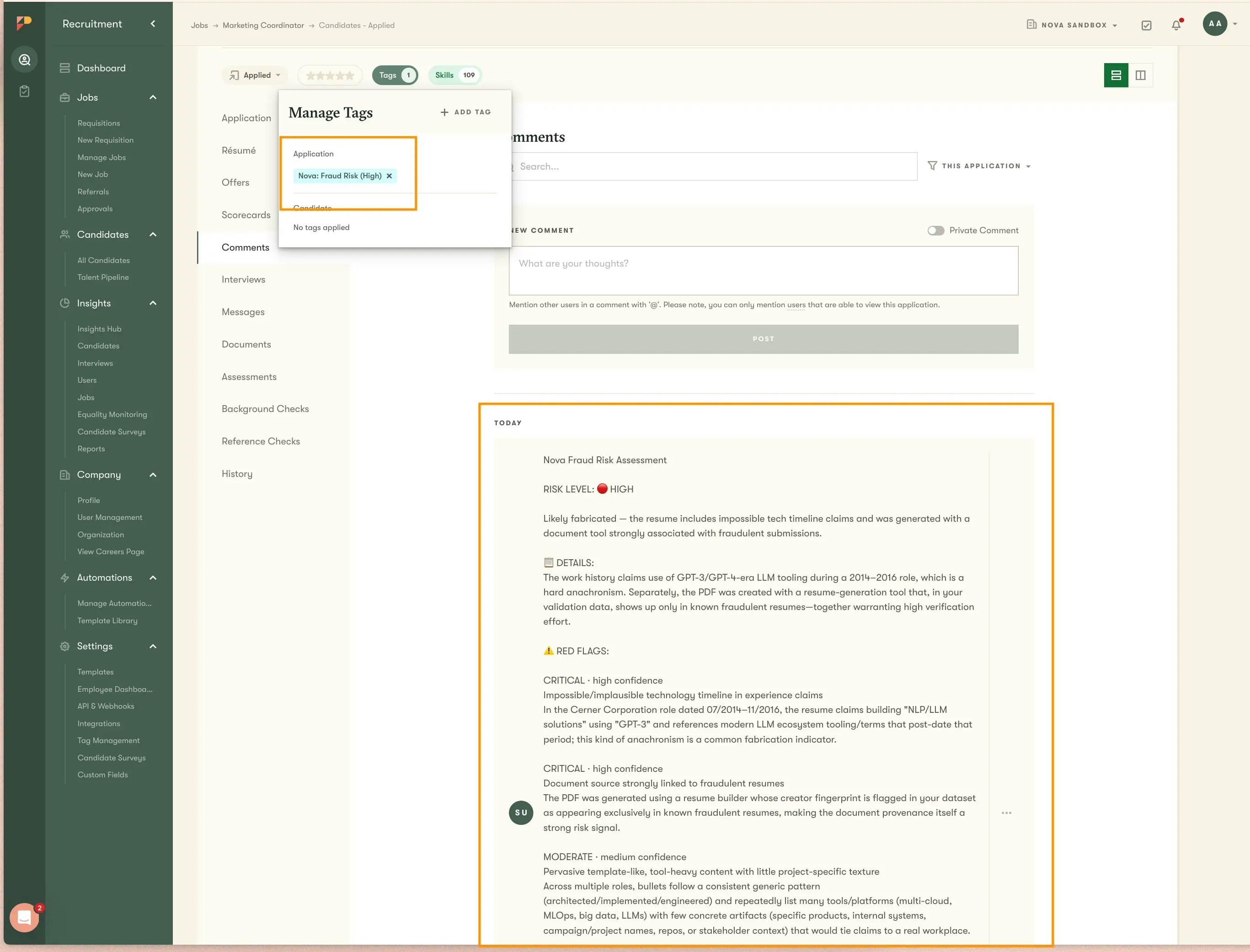
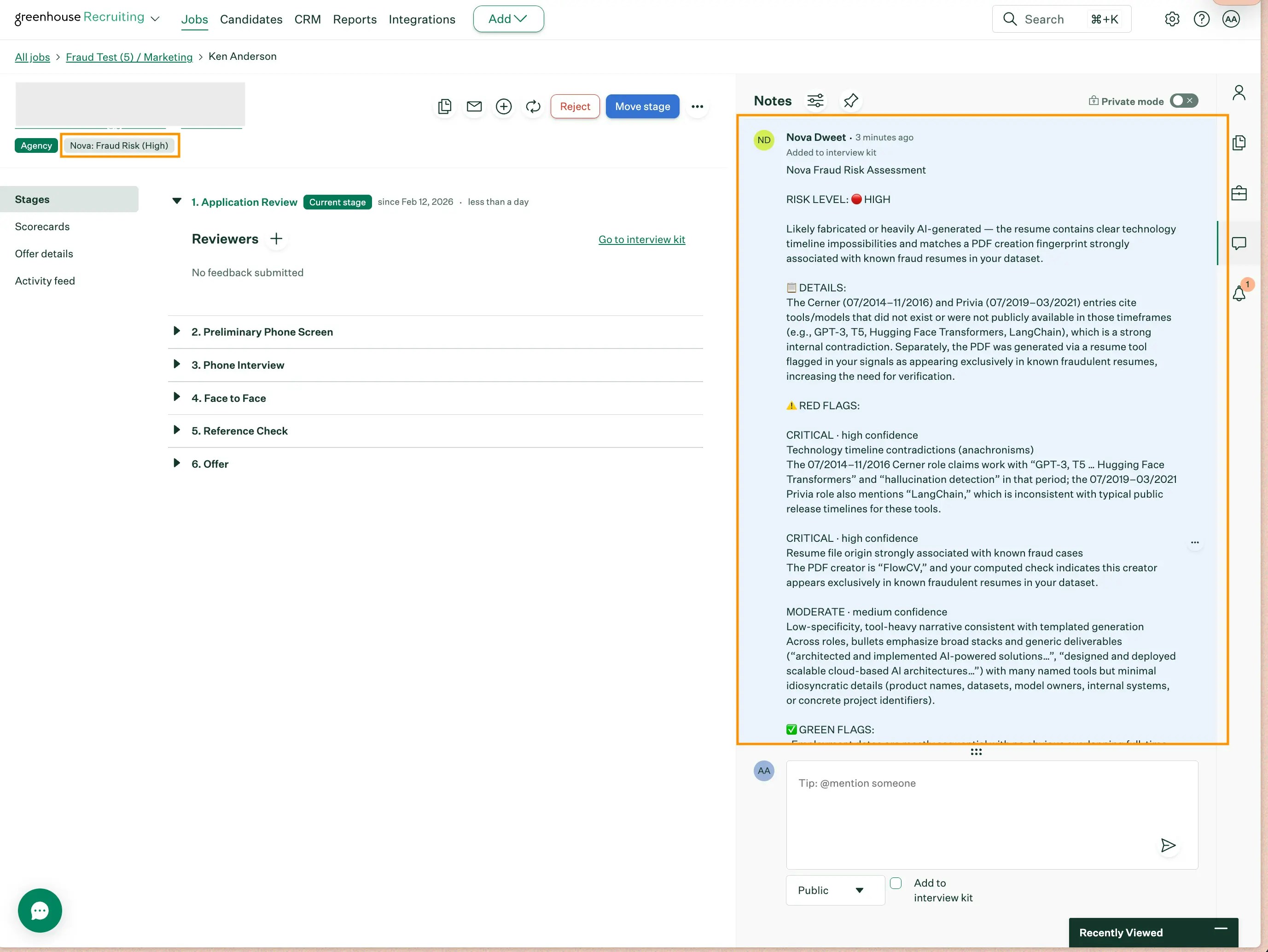
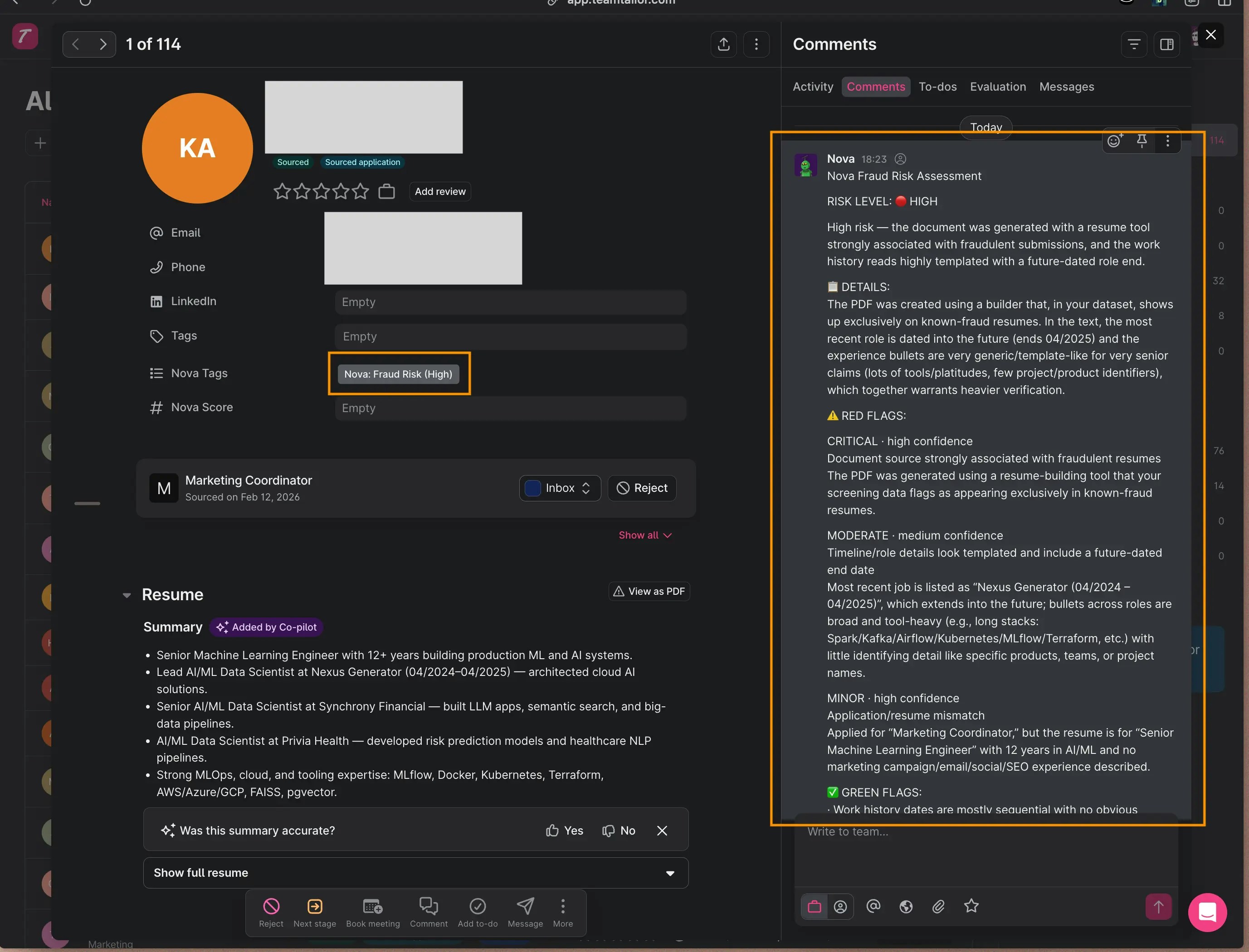
Each fraud analysis produces a structured note in your ATS with these sections:- Risk level: Low, Medium, or High
- Verdict: A one-line takeaway summarizing the key concern or all-clear
- Summary: Supporting detail explaining the reasoning behind the risk level
- Red flags (up to 3): Specific concerns with evidence from the resume or external signals, ranked by severity
- Green flags (up to 2): Reassuring signals that support legitimacy
- Verification questions (up to 3): Numbered questions you can ask in interviews to verify claims
Risk levels explained
| Risk level | What it means | Recommended action |
|---|---|---|
| Low | No meaningful concerns found | Proceed normally |
| Medium | Some structural concerns or signal convergence | Ask the verification questions during screening |
| High | Strong evidence of fabrication from multiple independent sources | Prioritize verification before advancing |
How it looks in your ATS
- Ashby
- Lever
- Pinpoint
- Greenhouse
- Teamtailor
Benchmark and Accuracy
We maintain an internal benchmark of hundreds of real resumes sourced from production hiring pipelines, including confirmed fraudulent applications and verified legitimate ones. Every change to the fraud detection system is validated against this benchmark before reaching production.Key metrics at the recommended operating point
| Metric | Value | What it means |
|---|---|---|
| Precision | Over 93% | When Nova flags a resume, it is correct over 93% of the time |
| False alarm rate | Under 4% | Fewer than 1 in 25 legitimate resumes are incorrectly flagged |
| High-confidence precision | 100% | At the highest confidence level, Nova has zero false positives across the full benchmark |
Configuring Fraud Detection
Navigate to Settings in your Nova dashboard to configure fraud detection.Settings
| Setting | Description | Default |
|---|---|---|
| Enable fraud detection | Toggle fraud analysis on or off | Disabled |
| Score threshold | Minimum Nova score (0-10) required to trigger fraud analysis | 7 |
Frequently Asked Questions
What happens if fraud detection fails?
What happens if fraud detection fails?
Fraud detection is designed to fail gracefully. If the analysis encounters an error, the candidate’s score and ATS note are unaffected. The scoring result is always delivered regardless of whether fraud detection succeeds.
What should I do when a candidate is flagged?
What should I do when a candidate is flagged?
Use the verification questions provided in the risk assessment during your screening call or interview. Most concerns can be resolved by asking the candidate to walk through specific claims on their resume. A medium risk flag means “ask some questions,” not “reject the candidate.”