

Field Guide: Stable Shortlists in the Age of AI
Why you’re right to be skeptical
- Volume without signal: Easy‑apply and automation inflate inbound; sameness rises, triage load increases.
- ATS search stalls: Keyword filters bury qualified talent; teams rarely hire from their own database.
- Black‑box scores: A “92% match” without cited evidence won’t pass a hiring manager or legal.
- Out‑of‑workflow tools: If it lives outside the ATS, adoption dies.
- “AI bias” used as a catch‑all: Often the real issue is misalignment—no intake context, no calibration, no shared rubric.
Myth vs Reality
- Myth: “If AI were deterministic, rankings wouldn’t change between runs.” Reality: Instability comes from vague criteria. Clarity + calibration beats seeds.
- Myth: “Keyword search with a dash of embeddings is enough.” Reality: Without rubrics and receipts, your ATS stays a graveyard.
- Myth: “92% match” convinces hiring managers. Reality: Scores without evidence die in review or legal.
- Myth: “AI interviews replace first rounds.” Reality: Most roles need human first rounds—with better briefs.
The Playbook
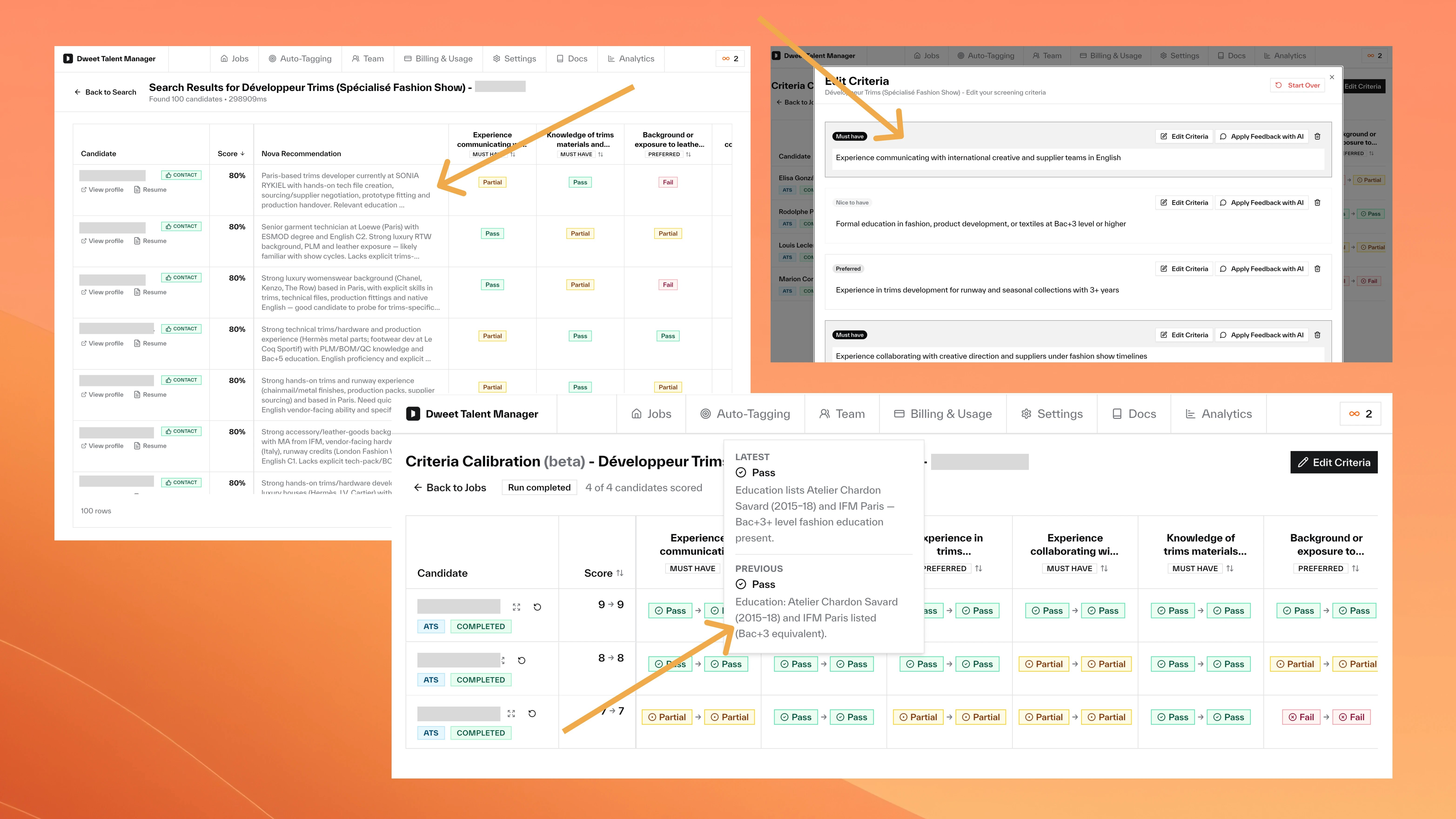
- Calibrate on a fixed cohort Turn intake into rules (must‑haves, preferred, nice‑to‑haves). Score 5–10 real resumes. Review PASS/PARTIAL/FAIL per criterion. Edit and re‑run on the same cohort until it behaves. Then roll out.
- Show the “why” Every suggestion should come with citations/excerpts mapped to the rule it satisfied.
- Keep it in the ATS Write scores, tags, comments and rediscovery back to the candidate profile and pipeline.
- Rediscover with the same rubric Reuse the calibrated rules on past applicants; surface suggestions into the live pipeline.
- Run a light evaluation heartbeat Keep a frozen set, add bias checks, schedule periodic reruns; catch drift early.
- Use deterministic reruns where needed Appeals, regressions, audits. Day‑to‑day: clarity and receipts.
Where AI belongs in your workflow (stage by stage)
- Intake → Criteria Builder: Convert kickoff notes into verifiable rules; capture must‑haves/preferred/nice‑to‑haves; define edge cases.
- Calibration on a fixed cohort: Score a small, stable set; align PASS/PARTIAL/FAIL per criterion with the hiring manager; iterate.
- Inbound screening (ATS‑native): Auto‑sort by score; attach cited evidence to every suggestion; tag consistently for filters and reporting.
- Rediscovery (same rubric): Re‑score past applicants with the calibrated rules; surface suggestions directly into the req pipeline.
- Interview assist (not interviews): Generate a just‑in‑time brief—strengths/gaps against the rubric, targeted questions, reminders to avoid personal heuristics.
- Evaluation heartbeat: Maintain frozen cohorts, run alignment checks and bias audits (including intersectional slices); detect drift early; enable deterministic reruns for appeals.
One‑Hour Fix (for your next role)
- 10 min: Turn intake into verifiable rules.
- 30–40 min: Calibrate on 5–10 resumes; tighten or split vague rules.
- 10 min: Roll out to inbound + rediscovery; save the cohort for checks.
Green Flags (buy) / Red Flags (wait)
- Green: Calibration on a fixed cohort; evidence behind every suggestion; ATS write‑back; evaluation hooks; deterministic reruns for appeals; rediscovery that reuses the rubric.
- Red: Prompt‑and‑pray; keyword bingo; black‑box scores; another browser tab; “trust us” instead of receipts.
FAQ
- Do I need determinism? For appeals/regressions, yes. For daily screening, calibration + evidence makes lists stable without it.
- Will this slow me down? The hour you spend calibrating saves days of rework and back‑and‑forth.
- How do I handle bias concerns? Treat bias as part of alignment. Add intersectional checks to the evaluation heartbeat and keep receipts.
Scripts you can use
- Hiring manager: “We’ll agree the rules, test them on a handful of real resumes, then roll out. Every suggestion has receipts, so we can challenge it. If something drifts, we’ll know.”
- Legal/compliance: “Decisions are rubric‑driven with cited evidence. We maintain frozen cohorts for periodic checks and deterministic reruns for appeals.”